Vietnamese Food: North, Central and South — The Complete Beginner's Guide
Vietnamese food is often introduced abroad through a single bowl of phở and a single sandwich, bánh mì. Both deserve their fame, but they are only the doorway. Vietnam is a long, narrow country whose kitchens change as surely as its weather. A meal in Hanoi does not taste like a meal in Huế, and neither tastes quite like breakfast in Saigon. The north prizes clarity and restraint. The centre delights in complexity, colour and chilli. The south cooks generously, sweetly and with armfuls of herbs.
This guide is the map for our Vietnamese Food tab. It explains why the country divides into three great food regions, what to look for in each, and how the pieces fit together. The individual dishes get their own articles in our daily series — phở already has its guide, and bánh mì and bún chả begin the run — so here we stay at survey height: the regions, their characters, and the names to know before you go deeper.
Why One Country Has Three Cuisines
Geography starts the story. Vietnam stretches more than 1,600 kilometres from the Chinese border to the Mekong Delta, but in places it is barely fifty kilometres wide. The north is a land of seasons, with a genuine winter in Hanoi and the broad, fertile Red River Delta. The centre is a narrow coastal strip squeezed between mountains and sea, exposed to typhoons and historically poorer soil. The south is tropical year-round, watered by the Mekong and rich in rice, fruit, fish and coconut.
History layered itself onto that map. The north lived for a thousand years under Chinese rule and then in the orbit of Chinese technique: noodles, dumplings, stir-frying, soy, and a respect for balance that still shows. The centre became the seat of the Nguyễn dynasty at Huế in the nineteenth century, and an imperial court demanded refinement — many small dishes, beautiful presentation, food as art and ceremony. The south, settled later and opened to the world through Saigon's port, absorbed French, Chinese, Khmer, Indian and global influences with an easy appetite, and sweetened its cooking with abundant sugar and coconut.
Add the practical differences — what grows, what swims, what the weather demands — and three cuisines are the natural result. They share one language and one table grammar, but they speak it with different accents.

The North: Hanoi and the Art of Balance
Northern food is the oldest layer of Vietnamese cooking, and its capital is Hanoi. The northern palate values purity: flavours are clear, seasoning is precise, and excess is suspect. Fish sauce is used, but with a lighter hand than in the south, and sugar is restrained. Black pepper matters more than chilli heat here — fresh chillies appear at the table for those who want them, rather than being cooked in by default. A northern cook is judged by what they leave out.
Phở was born here, in Hanoi and nearby Nam Định, in the early twentieth century: flat rice noodles in a broth that should be rich yet transparent, scented with star anise, charred onion and ginger, the beef sliced so the hot broth barely cooks it. Northern phở keeps the bowl comparatively austere — fewer herbs in the bowl, less sweetness, the flavour carried by broth and beef. Our dedicated phở guide follows its journey south and the argument it started; begin there if you want the full story of Vietnam's most famous bowl.
Bún chả is Hanoi's beloved lunch: grilled pork patties and slices of pork belly served in a warm, light dipping broth of fish sauce, vinegar, sugar and water, with a tangle of rice vermicelli and a basket of herbs on the side. You dip, you wrap, you alternate — the pleasure is in the assembly and in the char on the pork from the charcoal grill. It is the dish Hanoians point to when they want to explain their city: smoky, balanced, unhurried, eaten at a small table on the pavement at noon.
Bánh cuốn shows the north's delicate hand. Rice batter is steamed in a thin sheet over cloth, then rolled around minced pork and wood-ear mushroom, and served with fried shallots, herbs and a bowl of warm, diluted fish sauce for dipping. Good bánh cuốn is almost translucent and eaten within moments of the steamer. It is breakfast food, made to order at stalls where the cook's ladling and lifting becomes a small performance.
Chả cá is Hanoi's great speciality: turmeric-stained fish, classically a river fish, pan-fried at the table with a startling amount of dill and spring onion, then tumbled over rice vermicelli with peanuts and herbs. The dish is so identified with the capital that a street in the Old Quarter is named for it. It also gives the beginner a clue to the north: dill, so important across the Mekong in Laos, thrives here too, and the frying is done at the table so the herbs perfume the air as much as the plate.
Around these anchors sit the north's supporting cast: bún thang, an elegant shredded chicken and egg noodle soup for festivals; xôi, sticky rice in its savoury breakfast forms — one of the few places Vietnam leans on the glutinous grain Laos builds its whole table around; and snails, ốc, served in shellfish stalls with lemongrass and ginger. Winter in Hanoi adds its own comforts: hot bowls, fried cakes, and coffee taken strong and black. The north does not shout. It rewards attention.
The Centre: Huế, Heat and a Hundred Small Dishes
Central Vietnam cooks with more fire and more fuss than either end of the country, and both qualities trace to Huế, the old imperial capital. Legend in the city holds that the Nguyễn emperors demanded variety at every meal — dozens of dishes, none repeated carelessly, each portion small enough to be perfected. Whether or not every court story is true, Huế's food still behaves as if it were: many little plates, intricate garnishes, food coloured and shaped with unmistakable care.
The centre's seasoning runs hotter and saltier than the north's. Dried chillies, fresh chillies, chilli oils and fermented shrimp paste give central dishes their punch, and the region's cooks are famously unafraid of intensity. Yet the heat sits inside structure — small portions, contrasting textures, something crisp against something soft, something fermented against something fresh.
Bún bò Huế is the centre's great soup: a lemongrass-deep, chilli-red beef broth, thicker and more assertive than phở, served over round rice noodles with slices of beef, pork knuckle for those who want it, and cubes of congealed blood for those who truly want it. It tastes of a city that likes its breakfasts serious. In our daily series it gets its own day; here, know it as phở's bolder central cousin — the soup that proves Vietnamese noodle soups are a family, not a single dish.
Around Huế gathers a constellation of small, nameable things: bánh bèo, steamed rice cakes in tiny saucers topped with dried shrimp and crisp pork skin; bánh nậm and bánh lọc, delicate rice and tapioca dumplings, the latter translucent enough to show the shrimp inside; and cơm hến, rice with tiny river clams, herbs, peanuts and chilli — a humble dish refined into a local emblem. A central meal often means ordering five or six of these small plates rather than one large one.
South of Huế, in Quảng Nam province, the cooking stays punchy but turns rustic. Cao lầu, Hội An's signature noodle, uses a firm, chewy noodle with slices of char siu-style pork, crisp crouton-like squares, herbs and very little broth — the dish is inseparable from its old trading-port town. Mì Quảng spreads turmeric-yellow noodles in a shallow bowl with a ladleful of rich broth, pork, shrimp or chicken, a big rice cracker, peanuts and herbs: a noodle dish that eats almost like a salad. Both appear later in the daily series in their own right.
Bánh xèo, the sizzling turmeric crêpe folded around pork, shrimp and bean sprouts, has central roots — its name is the sound it makes in the pan — before travelling south and growing larger and more coconut-rich there. That journey, centre to south, is a pattern you will taste again: Vietnam's dishes migrate, and each region edits them.

The South: Saigon, Sweetness and Abundance
If the north whispers and the centre performs, the south feasts. Southern Vietnam — Saigon (Ho Chi Minh City) and the Mekong Delta below it — is the country's larder: rice in surplus, orchards of tropical fruit, rivers full of fish, coconut palms everywhere. The southern palate is sweeter than the north's, uses fish sauce more boldly, and treats fresh herbs not as a garnish but as a course: whole branches of herbs arrive at the table and are eaten by the handful.
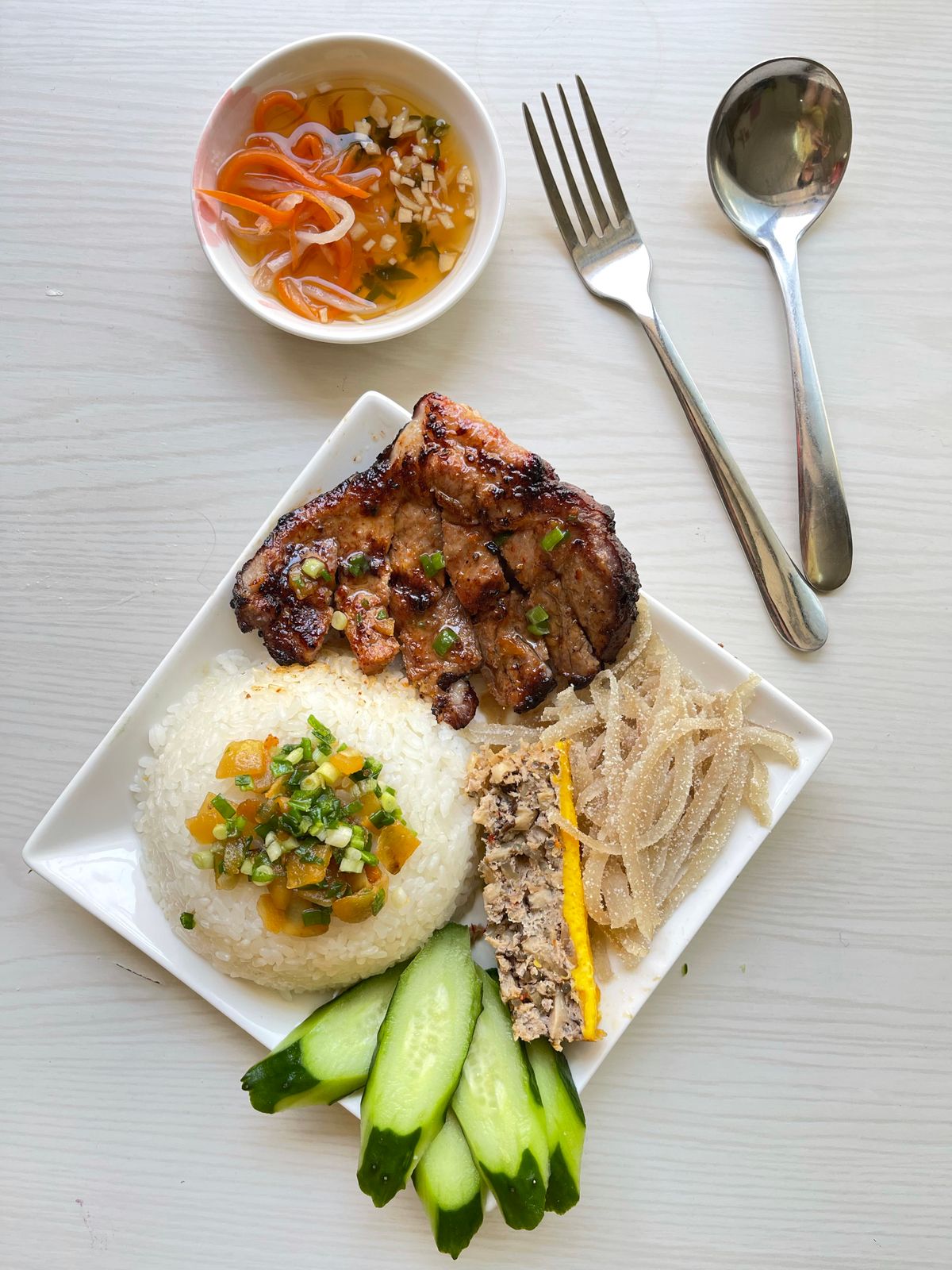
Breakfast is a headline meal here, and its hero is cơm tấm: broken rice — the cracked grains once considered the miller's leftovers — served as a fragrant plate with a grilled pork chop, shredded pork skin, a steamed egg-pork loaf and pickles, dressed with sweet fish sauce and scallion oil. It is filling, cheap and deeply Saigonese, the working city's morning monument. Our daily series gives it a full day of its own.
Hủ tiếu is the south's other great noodle soup, and it tells the region's mixed history in a bowl: a pork-based broth (with a Cambodian chapter in its ancestry via Kuy teav), chewy clear rice noodles, pork, prawns, chives and lettuce, served wet or dry with a side of broth. Where phở is about purity, hủ tiếu is about plenty — more components, more garnish, more choice.
Then there is bánh mì, which began with the French baguette and became entirely Vietnamese in the south: a crisp, thin-crusted roll with an airy middle, spread with pâté and mayonnaise, layered with cold cuts or roast pork, pickled carrot and daikon, cucumber, coriander and chilli. Saigon reinvented the sandwich the way it reinvents everything — by loading it generously and seasoning it brightly. Its story opens our daily dish series, and it is the perfect example of the south's genius for adoption.
The Mekong Delta adds the river's own table: cá kho tộ, fish caramel-braised in a clay pot; canh chua, the sweet-sour tamarind soup with pineapple, tomato and river fish; lẩu mắm, the great fermented-fish hotpot, funky and herbal at once; and fruit eaten as seriously as any dish — mangosteen, rambutan, pomelo and durian in their seasons. Southern cooks also inherited coconut milk in a way the north never did, folding it into crêpes, sweets and the sticky, colourful world of chè dessert soups.
The south's table is the most open in Vietnam: Chinese noodle houses, Khmer-influenced soups, French bread and coffee, Indian curries in Saigon's back streets. What makes it coherent is the palate — sweet, herbal, generous — and a confidence that more is a flavour too.
The Grammar They All Share
Three regions, three accents — but one grammar, and learning it helps you read any Vietnamese menu. Fish sauce is the foundation, the salty depth under almost everything, adjusted in strength by region and always balanced rather than raw. Fresh herbs — mint, perilla, Vietnamese coriander, Thai basil, lettuce, bean sprouts — are structural, not decorative; they are how a rich dish stays bright. Rice appears in every form imaginable: steamed grains, broken rice, vermicelli, flat phở noodles, round bún, steamed sheets, fermented batter cakes, crisp crackers. Vietnam may be the world's most inventive rice culture, turning one grain into a hundred textures.
Balance is the philosophy underneath: hot against cool herbs, sour against sweet, salty against fresh, crisp against soft, cooked against raw. A Vietnamese meal is engineered so that no single sensation runs unopposed — even the centre's fiercest chilli arrives with herbs, rice and something fermented to argue with it. Dipping sauces, mixed at the table to each eater's hand, are where the balance becomes personal: your nước chấm is never exactly mine.
Across the River: Vietnam beside Laos and Isan
Readers of this blog know the tables across the Mekong, and the comparison sharpens both. Lao and Isan cooking builds its meals around sticky rice rolled by hand, funky fermented fish — padaek, pla ra — bitter herbs, dill, and chilli heat that stands plainly on the plate. Vietnam, by contrast, builds around noodles and rice in endless forms, a brighter, more herbal freshness, and fish sauce used as a seasoning to be balanced with lime and sugar rather than as a funk to be celebrated. Vietnam's sourness leans on lime and tamarind; its sweetness, especially in the south, would startle a Luang Prabang cook; its coconut restraint in the north would puzzle a Bangkok one.
Neither table is better. They are neighbours answering the same landscape differently — one from the forest and the fermented jar, the other from the noodle stall and the herb basket. Even the overlaps are instructive: dill in Hanoi's chả cá echoes its starring role in Lao mok and or lam; Vietnam's savoury xôi shows sticky rice visiting a cuisine that otherwise prefers its rice loose; and Huế's love of fermented shrimp paste is a first cousin to the Mekong love of fermentation. Eat across the border and the whole region starts to make sense as one long conversation.

Where to Start: A First Tasting Order
If you are new to Vietnamese food, eat in this order and the country will explain itself. Begin in the north with a bowl of phở in the northern style, all clarity, then a pavement lunch of bún chả for Hanoi's smoke and balance, and chả cá for the dill. Move to the centre for bún bò Huế and a spread of Huế's small cakes — order several, share everything. Try cao lầu and mì Quảng in their Quảng Nam home style to see how the centre edits noodles. Finish in the south: cơm tấm for breakfast, hủ tiếu wet or dry, a loaded Saigon bánh mì, and something from the Mekong — canh chua or a clay-pot fish — before a glass of chè for the road.
At every stage, watch the herbs: how many, which ones, and how the locals fold them in. Ask what is in the dipping sauce. Eat breakfast like it matters, because in Vietnam it does. And when a dish exists in two regions, taste both versions — the argument between north and south over the same bowl is one of the pleasures of this cuisine.
Follow the Table
This overview anchors our Vietnamese Food tab, and the details live in the daily dish series running under it — one dish at a time, from bánh mì and bún chả onward, each with its own history and way of eating. Start here for the map, then walk the streets one bowl at a time.


Comments
Post a Comment