The Complete Guide to Isan Food: Northeast Thailand on a Plate
Cross the Mekong from Vientiane to Nong Khai and almost nothing about the food changes. The language stays Lao. The sticky rice still comes to the table in woven bamboo baskets. The papaya salad still arrives loud with fermented fish, and the heat still makes no apology. You have entered Isan — Thailand's northeast, some twenty provinces and roughly a third of the country's people, most of them ethnically Lao. Bangkok will tell you this is Thailand's spiciest, funkiest, most exciting regional kitchen, and for once Bangkok is underselling it. It is the Lao table on the Thai side of the river, shaped by a dry plateau, deep poverty turned into ingenuity, and a pride that seasons everything. That is exactly why the Isan tab lives on this blog: to eat Isan food is to eat Lao food's closest sibling, and the argument between them is the friendliest one in Southeast Asia.
One People, Two Banks of the River
The Isan plateau — the Khorat Plateau, walled by hills and drained by the Mekong and its tributaries — was Lao country for centuries, part of the world of the Lao kingdoms long before modern borders. When Siam took control of the Lao territories in the nineteenth century, whole communities were moved across the river and resettled on the plateau, and the Lao states east of the Mekong eventually became Laos while their cousins west of it became Thai citizens. The Thai state later promoted the name "Isan" — from an old word for the northeast — and Bangkok's language and schooling, but the kitchen never fully converted. Grandmothers in Khon Kaen and grandmothers in Vientiane still cook recognisably the same food.
The land explains the rest. The plateau is high, dry and stubborn: thin soils, a long dry season, ponds and paddies rather than orchards, and the sea very far away. A cuisine grows out of that. Almost nothing can be wasted, fresh fish must be preserved before it spoils in the heat, and flavour has to be built from fermentation, smoke, herbs and chilli rather than from rich ingredients the region never had. Isan food is what brilliant cooks do with very little — and the "very little" became a style the whole country now craves.
The Flavour Signature
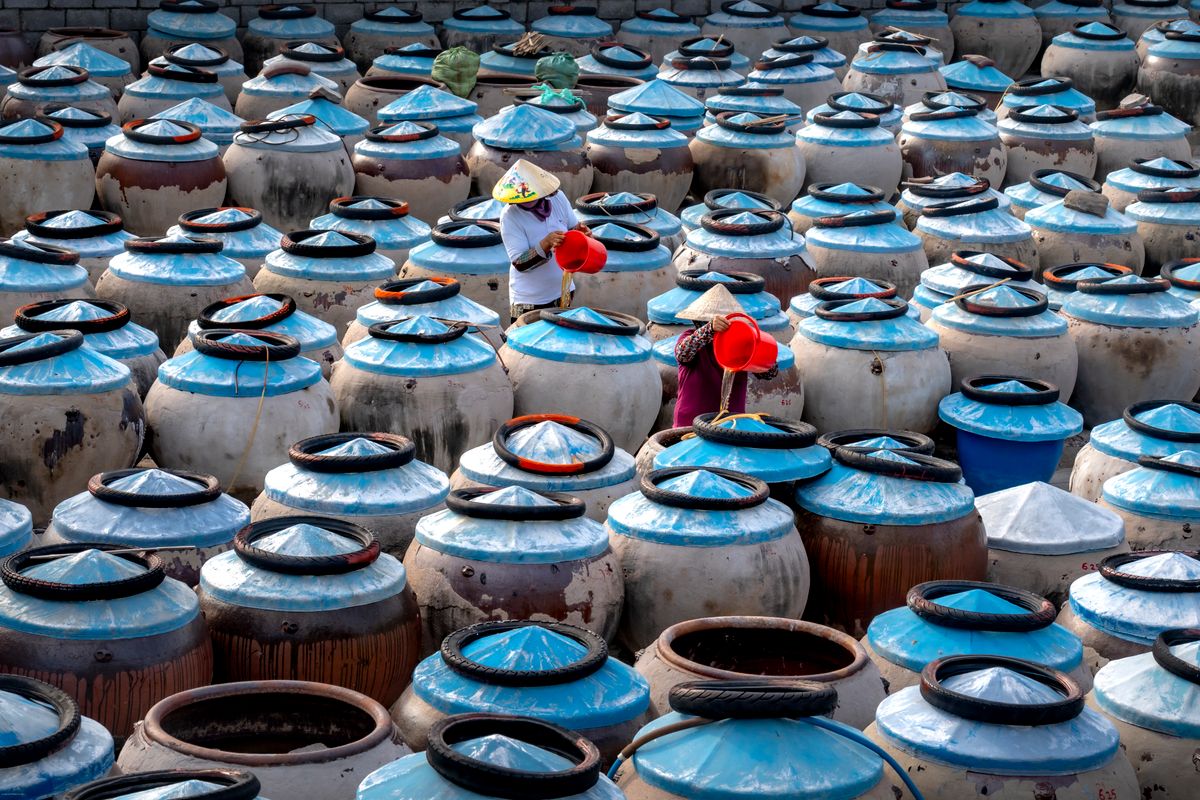
Pla ra above all. The soul of the Isan kitchen is pla ra: freshwater fish fermented with salt and roasted rice or rice bran until it becomes a murky, powerful, utterly distinctive seasoning — part sauce, part paste, wholly non-negotiable. Where central Thai cooking reaches for clear, filtered fish sauce, Isan reaches for pla ra, and the difference is the difference between a stock cube and a stock pot. It goes into papaya salad, soups and dips; cooked down, its raw aggression softens into a deep, round savouriness that Isan people taste as home and outsiders learn to crave, usually within one meal. A cook in Isan judges pla ra the way a winemaker judges vintages: by smell, by age, by village.
Heat without mercy. Isan food is among the hottest in Thailand, and the heat is direct — fresh and dried chillies by the handful, chilli flakes ground coarse, nothing sweet standing in the way to soften it. The word the region lives by is saep: delicious, but delicious in the Isan sense — hot, sour, salty, alive. If it isn't a little bit challenging, it isn't saep.
Sour from the land. Lime first, then tamarind, then the sourness only this region has: fermented notes from pla ra itself, sour bamboo, unripe fruit, and — in season — the lemony pop of red ant eggs. Vinegar plays almost no part.
Herbs and green things. Mint, sawtooth herb, spring onions, shallots, holy and lemon basils, lemongrass and galangal, plus raw vegetables served with everything — cabbage, long beans, cucumber, herbs by the fistful — to cool and crunch between bites.
What is missing matters. There is almost no coconut milk: the dry plateau grows few palms, and unrefrigerated coconut milk spoils fast. There is very little sugar compared with Bangkok cooking — a background pinch, not a balancing act. Richness comes instead from grilled meat, from pork fat, from fermentation's depth. And under everything sits khao niao, sticky rice, the true base of the cuisine — rolled into balls by hand and used to carry every other flavour to the mouth.
The Canon
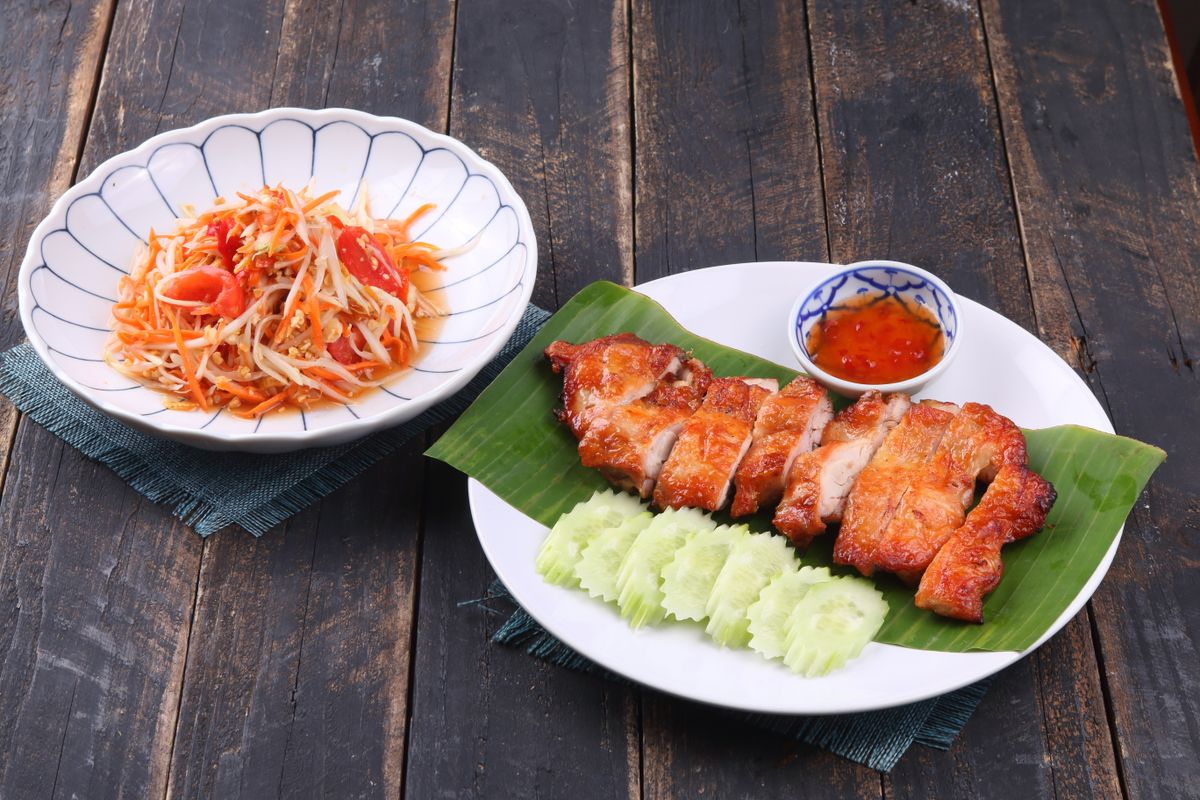
The som tam family — in brief. Green papaya pounded in a clay mortar with a wooden pestle is Isan's most famous export, and it is a family, not a dish. Tam pla ra, funky with fermented fish and often fermented field crab, is the home style; tam Thai — sweeter, peanut-flecked, made with fish sauce — is the Bangkok adaptation the world met first. Between them sit tam sua (pounded with rice noodles folded through), tam khao pod (sweetcorn), tam with salted egg, with fermented bamboo, with whatever the market gave up that morning. The full family tree gets its own article on this blog; here it is enough to know that in Isan the mortar is clay, the dressing runs to pla ra, and the heat is set by the person eating, not the person apologising.
Larb and nam tok. Larb — minced pork, chicken, duck or beef tossed warm with toasted rice powder (khao khua), lime, dried chilli, shallots, mint and spring onion — is shared heritage: Laos calls it a national dish, Isan calls it its own, and both are right, because the dish predates the border. Isan larb tends to run hotter and louder, with chilli flakes forward and, in traditional versions, a whisper of bitterness prized by old hands. Its grilled cousin nam tok ("waterfall", for the juices that drip and hiss on the charcoal) uses the same dressing over sliced grilled pork or beef — the meat cooked first, then dressed like a salad. Duck larb, rich and dark, is the connoisseur's order.
Gai yang. Grilled chicken, marinated with garlic, coriander root, turmeric and fish sauce, split and flattened over charcoal until the skin crisps and the smoke does its work. The town of Wichian Buri made one style famous across Thailand, but every market town in Isan has its own grill and its own claim. Gai yang, som tam and sticky rice — eaten together, outdoors, with your hands — is the region's holy trinity and its happiest meal.
Tom saep. The hot-sour soup: pork ribs or beef in a clear, fierce broth of lemongrass, galangal, lime and chilli, with herbs thrown in at the end. No coconut milk, no gentleness — the name carries the region's favourite word, and a good tom saep should make your eyes shine. It is the soup that goes with drinking, with celebration, and with the larb course of a proper spread.
Jeow and pla ra bong. Every cuisine in this region runs on pounded dips, and Isan's daily bread is jeow made from pla ra itself — pla ra bong, the fermented fish pounded with chillies, shallots, lemongrass and garlic, sometimes fried down into a jar-keeping relish. A ball of sticky rice dragged through pla ra bong, with steamed vegetables and a piece of grilled fish, is the working lunch of the northeast: cheap, fast, and complete.
Gaeng nor mai. Bamboo shoot soup, and a masterclass in making a foraged ingredient sing. Fresh or fermented-sour bamboo (nor mai som) simmered in a broth darkened and bodied with yanang leaf juice — the green, slightly bitter extract that gives the soup its colour and its earthy depth — with mushrooms, herbs, chilli and pla ra underneath. No coconut milk anywhere near it. Sour, green, smoky: the taste of the rains arriving.
Grilled river fish. The Mekong and its tributaries — and, inland, the reservoirs and rice-paddy ponds — give the plateau its fish: catfish, snakehead, tilapia and a dozen smaller kinds. Fish is rubbed with salt and lemongrass and grilled over charcoal (ping pa), or packed in a salt crust and roasted until the flesh steams inside. Beside it often sits pla som, fish soured by a short fermentation with rice and garlic — a reminder that on this plateau, fermentation is not a flavour choice but a way of keeping the catch alive one more day.
How an Isan Meal Is Built
An Isan meal is not courses; it is a spread, served all at once and eaten together. In a village home it arrives on a low round tray or a mat on the floor; in a market restaurant, it covers the whole table. At the centre: sticky rice in its baskets, one per person. Around it, the canon in miniature — a som tam made to order, a larb or nam tok, something grilled, a soup to sip between bites, a jeow, and a plate of raw herbs and vegetables that is not garnish but equipment.
Everyone eats with the right hand: pinch off a small ball of rice, roll it, flatten it, use it to scoop the larb or drag through the jeow, then a bite of raw cabbage or a herb leaf to reset. Sharing is not a style choice, it is the mechanism — nobody orders "their" dish, and the fastest way to disgrace yourself at an Isan table is to eat as if you were alone. The cook watches the rice baskets; a guest's basket is never allowed to empty without comment, and usually without refill.
From the Fields: Insects and Foraged Foods
Now the part outsiders ask about, so let us be plain about it: insects in Isan are food, not a stunt. They are sold in markets in neat piles beside the vegetables, bought by grandmothers, and cooked at home — which is the surest sign something is ordinary and loved.
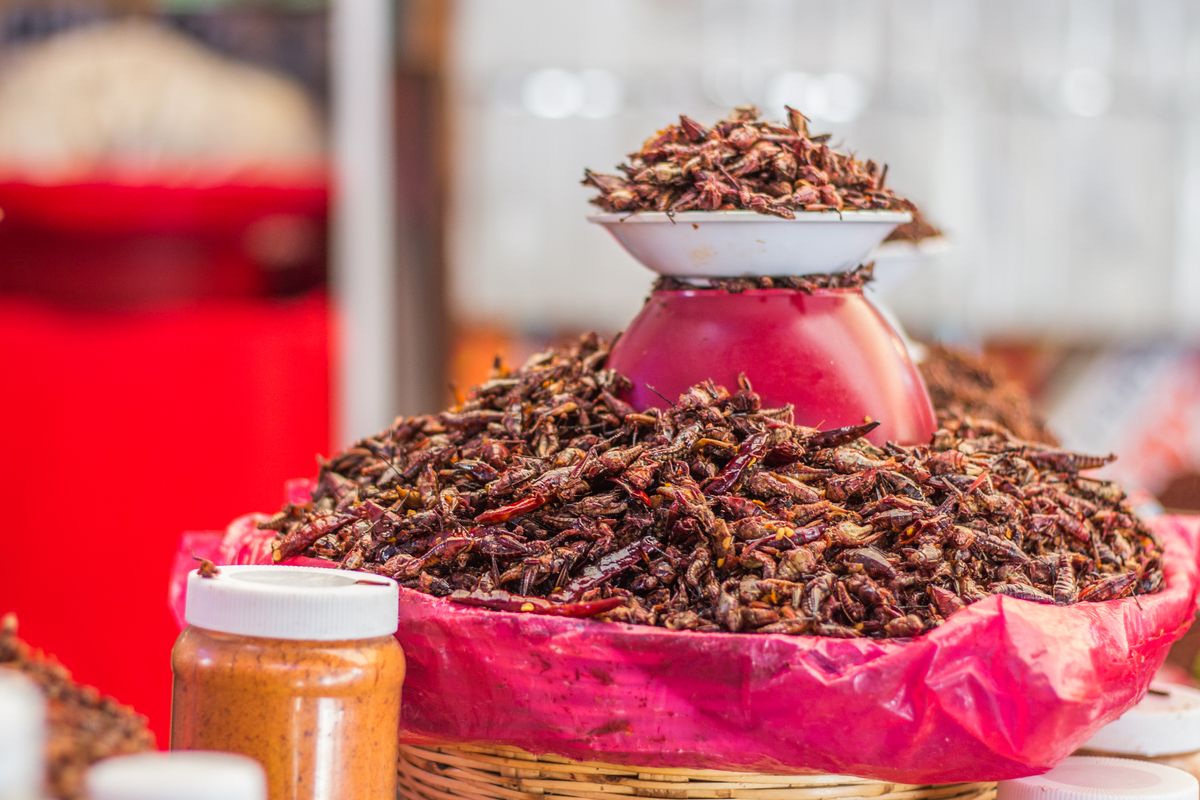
The prize is khai mod daeng, red ant eggs — the pearly white larvae and pupae of weaver ants, harvested from nests in mango and forest trees in the hot season and folded into a sour, herby salad (koi khai mod daeng) with shallots, mint and lime. They pop gently and taste bright and lemony, the sourness coming from the ants' own formic acid. Around them: crickets and grasshoppers fried crisp with kaffir lime leaf, silkworm pupae, grasshoppers from the rice fields after harvest, frogs (whole, grilled or in soups), rice-paddy crabs pounded into som tam, snails in curries, and mushrooms that appear in the forests after the first rains and are gone in weeks. This is protein and flavour gathered from a landscape that offers little to waste — the forager's pantry of a dry land, and, to the people who grew up on it, simply dinner.
Isan Pride, and the Bangkok Table
For most of the twentieth century, Isan was Thailand's poor relation — the region Bangkok looked down on while depending on it completely. Isan workers built the capital: its construction crews, taxi drivers, factory hands and cleaners came, and still come, from the northeast. And they brought their kitchen with them. The som tam cart on a Bangkok soi, the larb stall outside a building site, the jeow packed in a worker's bag next to the sticky rice — Isan food colonised Bangkok from the bottom up, because the people who cooked it missed home and the people who tasted it were converted.
Today the flow has reversed into respect. Isan restaurants run from smoky shophouse grills to some of the most celebrated dining rooms in the capital, mor lam — the region's driving, witty folk music — plays at its festivals, and saep has become a national compliment. But the pride was always there: ask anyone from Isan and they will tell you the food was never the problem. The problem was only ever that Bangkok hadn't caught up yet.
Isan or Lao? The Same Table, Different Accents
So how does the food of Isan differ from the northern Lao food this blog calls home? Less than either side admits, and the differences are accents, not grammar.
The ferment. Padaek and pla ra are cousins — both whole freshwater fish fermented with salt and rice — but they are not twins. Northern padaek is typically thicker, darker and chunkier, used almost as a paste-ingredient in its own right; pla ra, especially as it travelled, is as often a seasoning liquid-and-paste in one, and Isan cooks wield it with a heavier hand in salads and soups. Every village argues its own version is the true one, which tells you how little separates them.
The herbs. Northern Lao cooking is the more herb-obsessed of the two — dill in everything, bitter forest leaves, sakaan and makhwaen from the hills. Isan uses its herbs generously too, but leans more on mint, sawtooth herb and spring onion in the larb bowl, and dill appears only in some soups rather than as a signature.
The sweetness. Both cuisines reject Bangkok's sugar balance, but Isan — especially as cooked in the capital and for Thai palates — has let a little more sweetness in around the edges; a northern Lao cook, tasting it, will often pronounce it "Bangkok-style" with a raised eyebrow. Northern Laos stays stricter: more bitter, more sour, less compromise.
The influence of the capital. Isan food lives inside Thailand's national food culture, standardised and exported by it — the sweet, peanutty som tam the world knows is that process at work. Northern Lao food, across a quieter border, kept more of the forest and the village in it. Neither is more authentic; they are two answers to the same question, asked on opposite banks of one river.
Where to Go From Here
Start on one bank, then cross. The Lao tab on this blog takes you north into the hills — or lam, kaipen, the dill-and-forest cooking of Luang Prabang — while the Isan tab stays here on the plateau: the som tam family tree in full, the great grills, the markets of Khon Kaen and Udon Thani. Same rice basket, same mortar, same argument about whose fermented fish is better. Pull up a mat — you are welcome on both sides of the river.


Comments
Post a Comment