Nam Tok: "Waterfall" Grilled Meat Salad
Nam Tok: "Waterfall" Grilled Meat Salad
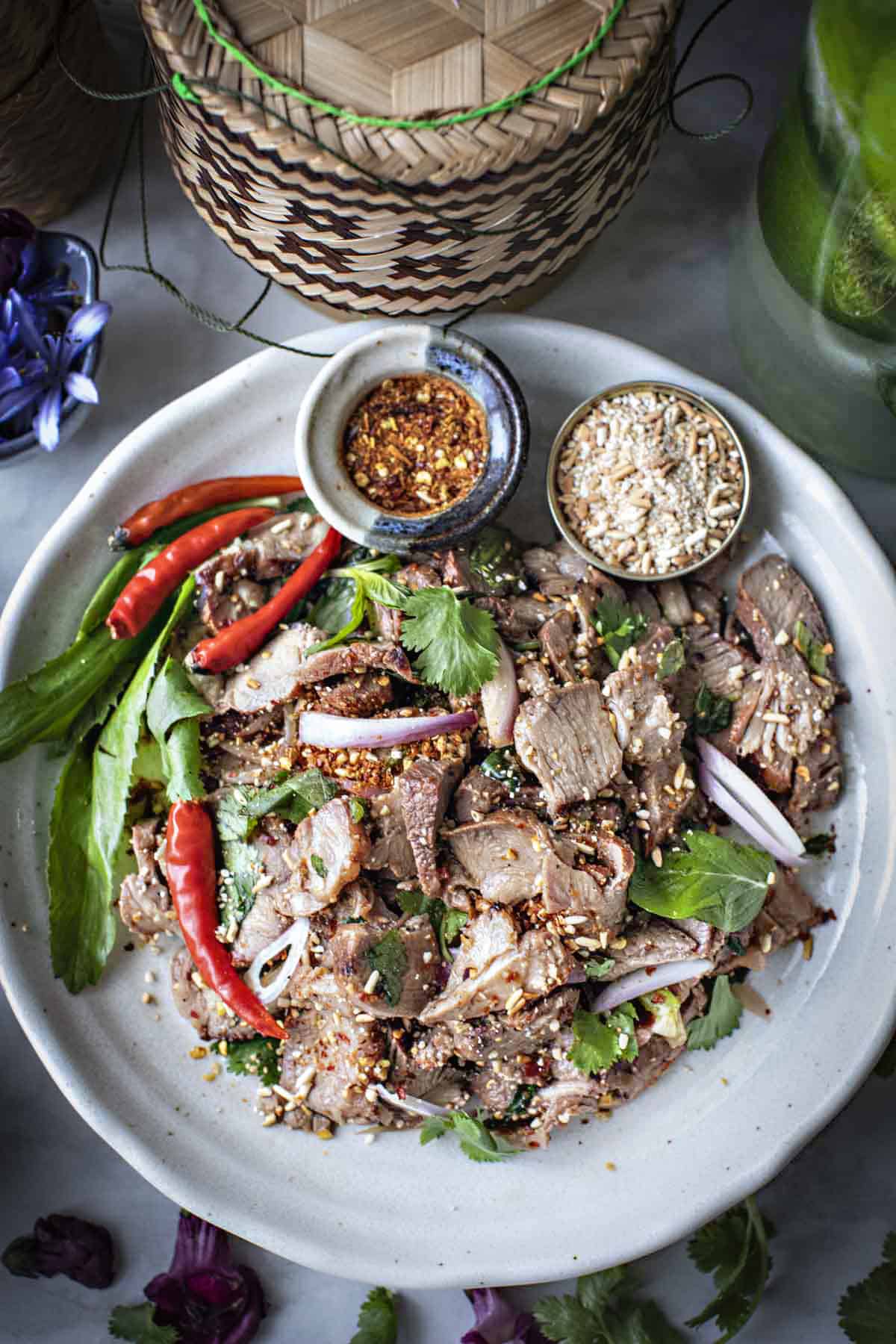
Photo: Simply Suwanee
Order a plate of Nam Tok in an Isan kitchen and you will hear the grill before you see the food: fat hissing and dripping over charcoal, meat juices falling in little spits and sizzles. That sound is the dish's name. Nam tok means waterfall in Thai, and cooks say the name comes from the juices that run and drip from grilled meat as it cooks — a small waterfall over the coals. Others point to the juices that pool in the bowl when the warm sliced meat meets lime, fish sauce and herbs. Either way, the plate that arrives is pure Isan: slices of charred, juicy grilled pork (or beef), still warm, tossed in a sharp, salty, fiery dressing with toasted rice powder, mint, shallots and chillies, eaten with sticky rice and a heap of raw vegetables.
Nam Tok and Larb: close cousins, different plates
Nam Tok is often confused with Larb, and the two do share a dressing — lime juice, fish sauce, dried chilli flakes and khao khua, the toasted glutinous rice pounded to a coarse, nutty powder that thickens the juices and adds a deep roasted flavour. The difference is the meat and how it is cooked. Larb starts with minced meat, cooked quickly (or, traditionally in some places, served raw). Nam Tok starts with a whole piece of meat — pork neck or shoulder, or a good cut of beef — marinated lightly, grilled over charcoal until the outside is charred at the edges and the inside is still juicy, then rested, sliced, and only then dressed. You taste the grill in every bite. Think of Larb as a minced salad and Nam Tok as a steak salad, Isan style.
What goes on the plate
- The meat: pork neck (nam tok moo) is the everyday favourite in Isan — well-marbled, forgiving on the grill, and juicy when sliced. Beef (nam tok nuea) is the other classic, cooked rare to medium so the slices stay tender and rosy in the middle
- The char: real charcoal if you can manage it. The smoky, blackened edges are not decoration — they are half the flavour, and they stand up to the fierce dressing
- The dressing: lime juice and fish sauce in near-equal measure, a pinch of sugar only if your limes are very sharp, and plenty of dried chilli flakes. It should taste hot, sour and salty all at once — adjust it on the warm meat, not in a separate bowl
- Khao khua: toasted rice powder, added last so it stays nutty and does not turn to paste. It thickens the meat juices into a sauce that clings to every slice
- The herbs: fresh mint first — a generous handful — plus sliced shallots, spring onions, coriander and, if you can find it, sawtooth herb for its wild, peppery green note
- The sides: sticky rice, always, for scooping, and raw vegetables to cool the heat — cabbage wedges, long beans, cucumber and Thai basil
An Isan table dish, made to share
In Isan, in northeastern Thailand, Nam Tok rarely arrives alone. It lands in the middle of a shared spread — Som Tam pounded to order, Gai Yang turning on the grill, a bamboo-shoot soup, baskets of sticky rice opened at the table. The eating is hands-on: pinch off a ball of sticky rice, flatten it a little, use it to pick up a slice of meat and a mint leaf, and chase it with a bite of raw cabbage. The flavours are deliberately loud, because the food has work to do — this is hot-climate, hard-working country cooking, where salt, sour and chilli wake you up and sticky rice keeps you going. Restaurants all over Thailand, and Thai restaurants around the world, have adopted the plate, but at its best it still tastes of charcoal smoke and a mortar of toasted rice.
The slicing matters
Two small techniques decide whether your Nam Tok is great or merely good. First, rest the meat. Five minutes off the grill lets the juices settle, so they end up in the salad rather than on the chopping board. Second, slice against the grain, and not too thin — slices about half a centimetre thick keep a satisfying chew and a juicy centre. Toss the warm slices in the dressing while they are still warm: they drink in the lime and fish sauce, the shallots soften slightly, the mint wilts just a touch, and the rice powder turns the whole thing glossy. Serve it straight away. Nam Tok does not wait well — the lime keeps "cooking" the herbs and the rice powder keeps drinking the juices.
Home recipe: Nam Tok Moo (serves 2 as a main, 4 as part of a shared table)
- Marinate the pork: take 500g pork neck or pork shoulder steak. Rub it with 1 tablespoon fish sauce, 1 teaspoon soy sauce, half a teaspoon sugar and a pinch of ground black pepper. Leave for at least 30 minutes, or up to 2 hours in the fridge.
- Make the khao khua if you do not have it: dry-toast 3 tablespoons uncooked glutinous (sticky) rice in a pan over medium heat, stirring constantly, until deep golden and smelling nutty, 5–7 minutes. Cool, then pound or grind to a coarse powder — a few gritty bits are good. You will use about 2 tablespoons; the rest keeps for weeks in a jar.
- Grill the meat: cook the pork over hot charcoal, a very hot griddle or a cast-iron pan for 5–7 minutes per side, until nicely charred at the edges and just cooked through with the faintest blush inside (for beef, aim for rare to medium). Rest for 5 minutes.
- Slice: cut the rested meat against the grain into slices about 5mm thick and tip them, with all their juices, into a warm mixing bowl.
- Dress it warm: add 3 tablespoons lime juice, 2 tablespoons fish sauce, 1–2 teaspoons dried chilli flakes (start with 1 if you are cautious), half a teaspoon sugar and 2 tablespoons khao khua. Toss well and taste — it should be hot, sour and salty in balance. Add more lime or fish sauce a spoonful at a time until it sings.
- Add the herbs: fold in 3 small shallots, thinly sliced, 2 spring onions cut into short lengths, a big handful of fresh mint leaves and a small handful of coriander leaves (plus chopped sawtooth herb if you have it). Toss once more, quickly.
- Serve at once: pile onto a plate, scatter a little extra khao khua and chilli flakes over the top, and bring it to the table with sticky rice and a plate of raw cabbage, long beans, cucumber and basil.
The home-cook's rule: grill first, dress warm, serve immediately. Char, juice and timing do the work in Nam Tok — a tame grill or a salad left standing will give you a pleasant plate, but not the waterfall.
A salad that sounds like rain on coals
Nam Tok is a reminder of how much Isan cooking gets from so little: one good piece of meat, a fire, rice toasted in a dry pan, lime, fish sauce, chillies and herbs. No long simmering, no long shopping list — just heat, timing and balance. If you are travelling in the northeast, order it where the grill is charcoal and the sticky rice comes in a woven basket, and listen for the drip and hiss that gave it its name. And if you are cooking at home, fire up the hottest pan you own, make your own khao khua once, and you will make it again and again. One mouthful — smoky meat, sour lime, nutty rice, cool mint, a ball of sticky rice — and the waterfall makes perfect sense.


Comments
Post a Comment