Hokkien Mee: The Old Town's Fried Noodle Icon
Hokkien Mee: The Old Town's Fried Noodle Icon
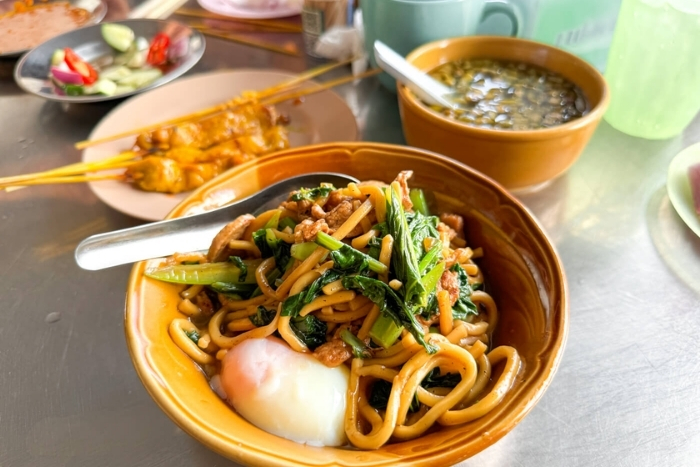
Photo: AutourAsia
Walk into a busy food shop in Phuket Old Town at lunchtime and listen. Under the fans and the clatter of plates you will hear the same order called out again and again: one Hokkien mee, one more Hokkien mee, extra egg. What arrives is a bowl of thick, golden yellow noodles, glossy with a dark, savoury sauce that is not quite a soup and not quite dry — wok-fried, then braised for a moment in rich prawn and pork stock so every strand drinks it in. Tucked through the noodles are prawns, squid, slices of pork, fish cake and leafy greens, and on top, in the houses that do it properly, sits a soft egg, its yolk ready to break and enrich the whole bowl. It is Phuket's signature noodle, the dish locals measure a new shop by, and one of the clearest tastes of the island's Hokkien Chinese heritage.
A noodle that crossed the sea
Phuket's food cannot be understood without its tin-mining past. In the 19th and early 20th centuries, Hokkien Chinese families from Fujian — many arriving by way of Penang and Malaya — came to work and trade in Phuket's tin boom, and they brought their kitchens with them. The island's famous dishes grew from that meeting of Hokkien cooking, Malay ingredients and Thai heat: moo hong's slow soy braise, o-tao's oyster omelette, and this bowl of yellow noodles. In Penang and Singapore, cousins of the dish travel under similar names — fried Hokkien prawn mee, Hokkien char — but Phuket's version has its own unmistakable character: thick round yellow noodles, a generous ladle of prawn-stock gravy so the bowl stays saucy, and that soft egg on top, which in Phuket is not an extra. It is the point.
What makes Phuket Hokkien mee itself
- The noodles: thick, round, wheat-and-egg yellow noodles — chewy, springy and sturdy enough to braise in stock without falling apart. Thin rice noodles need not apply; this is a noodle with presence.
- The stock: the soul of the dish. Prawn heads and shells and pork bones simmered into a deep, sweet, sea-tasting stock. The noodles are fried first, then the stock goes in and the wok is covered for a moment, so the noodles absorb the stock instead of just being coated by it.
- The sauce balance: dark and light soy, a little oyster sauce, a pinch of sugar — savoury first, faintly sweet, never cloying. The gravy should cling, glossy and brown, with just enough left in the bowl to spoon up at the end.
- The cast: prawns and squid from island waters, sliced pork, sometimes pork liver and fish balls or fish cake, and a big handful of greens — water spinach or choy sum — wilted in at the last moment so they stay bright.
- The egg: cracked over the finished noodles or served soft on top, yolk still runny. Break it, stir it through, and the gravy turns richer and silkier. Regulars order it without being asked; visitors learn after the first bowl.
- The table kit: dried chilli flakes, vinegar chillies, sugar and fish sauce sit on every table. Phuket eats this dish seasoned to taste — a little heat, a little sour — and a squeeze of lime is never wrong.
Where the Old Town eats it
The dish belongs to the Old Town's kopi shops and family noodle houses — the kind of places with marble-topped tables, tiled floors, sweet iced tea sweating in glasses, and a wok that has barely cooled in decades. Names are spoken of with real loyalty: shops around the Old Town and the Lock Tien food court area have served their versions for generations, and families argue, happily and at length, about whose stock is deepest and whose egg is runniest. The honest advice is the advice locals give for all great noodle towns: go where the lunch crowd is thickest, order the house Hokkien mee with the egg, add a plate of something fried to share, and do not rush it. Portions are generous, prices are neighbourhood prices, and the bowl in front of you is the same one the shop serves its own family.
How it differs from its cousins
Penang's Hokkien mee is a soup — a fiery prawn broth with two kinds of noodle. Singapore's fried Hokkien mee is drier, tangled with sambal and lime, and heavy on the wok-fried stock absorption too, but usually finished without the crowning soft egg. Phuket's bowl sits happily between them: fried like Singapore's, saucy almost like a braise, unmistakably its own because of the thick round noodle, the covered moment in prawn stock, and the egg. Put the three side by side and you can taste the family resemblance — and exactly where Phuket went its own way.
Home recipe: Phuket Hokkien Mee (serves 2–3)
- Make a quick prawn stock: peel 200g prawns and keep the heads and shells. Fry the heads and shells in a little oil until orange and fragrant, add 750ml water and a few slices of pork or a small piece of pork bone if you have one, simmer 20 minutes, then strain. This stock is the dish — do not skip it and do not use plain water.
- Prep everything before the wok heats: 400g fresh thick yellow Hokkien noodles (rinse briefly if very oily), the peeled prawns, 100g squid cut into rings, 150g sliced pork, a few slices of fish cake, 2 big handfuls of choy sum or water spinach cut short, 3 garlic cloves chopped, and 2–3 eggs at room temperature.
- Mix the sauce: 1 tablespoon dark soy sauce, 1 tablespoon light soy sauce, 1 tablespoon oyster sauce, 1 teaspoon sugar and a few shakes of white pepper.
- Fry: heat 2 tablespoons oil (pork lard if you want the full Old Town flavour) in a wok over high heat. Add garlic, pork and fish cake; stir-fry until the pork is just cooked. Add prawns and squid for 30 seconds — they finish later, so do not cook them through.
- Add noodles and stock: add the noodles and the sauce, toss hard for a minute, then pour in about 300ml of the hot prawn stock. Cover the wok and braise for 1–2 minutes — this is the Phuket moment, when the noodles drink the stock and turn glossy and deep-flavoured. Uncover; the bowl should be saucy, not soupy. Add a little more stock if it looks dry.
- Greens in: fold in the greens and stir just until wilted, about 30 seconds. Taste: it should be savoury, a little sweet, full of prawn. Adjust with light soy or a pinch of sugar.
- The egg: in a small pan, fry or gently poach the eggs until the whites are just set and the yolks still runny — or crack an egg over each portion of noodles in the wok for the final covered minute, the way many shops do. Serve the noodles in warm bowls, an egg on each, yolk ready to break.
- Serve: straight away, with dried chilli flakes, vinegar chillies and lime wedges on the side. Break the yolk, stir it through the gravy, and eat hot.
The stock rule: if the prawn stock is weak, the dish is weak, no matter how good your wok work is. Fry the shells hard, simmer them properly, and season the stock itself lightly — the noodles can only absorb what is actually there.
Why it endures
Hokkien mee endures in Phuket because it is history you can eat for lunch: Fujian noodles, island prawns, Thai seasoning and a century of tin-town mornings, all in one saucy, egg-crowned bowl. It is not a tourist invention and it is not a copy of Penang or Singapore — it is the Old Town's own, argued over by people who have eaten it all their lives. Order it where the wok never cools, take the egg, season it at the table, and you will understand Phuket a little better with every bite.


Comments
Post a Comment