Food of Thailand's Deep South: The Malay Table of Pattani, Yala and Narathiwat
Drive far enough south in Thailand and the country changes around you — quietly, completely, and deliciously. The wats give way to mosques with green domes. The signs gain a second script. The language on the street stops being the Thai you have been getting by on and becomes Yawi, the local Malay dialect written in Arabic letters. And the food — the food turns a corner too. This is the Deep South: the provinces of Pattani, Yala and Narathiwat, a Malay-Muslim heartland that has more in common, plate for plate, with Kelantan across the Malaysian border than with Bangkok a thousand kilometres north.
This blog mostly lives upcountry — Laos, Isan, the northern hills. But the Deep South earns its tab. It is one of the great regional tables of Southeast Asia, and one of the least written about in English. Here is how it works and what to eat when you get there.
A Country Within the Country
The Deep South was once the heartland of the Sultanate of Patani, a Malay trading kingdom that grew rich on the same monsoon routes as Malacca. It was absorbed into Siam only in the early twentieth century, and it never stopped being itself. The population is overwhelmingly Malay and Muslim. Friday is the week's hinge, not Sunday. Ramadan reshapes the eating year. The border with Malaysia is close and porous in the way borders between kin always are — families, marriages and recipes cross it constantly.
For the eater, the practical meaning is simple: this is not Thai food with a twist. It is Malay food that happens to be served inside Thailand, seasoned by the same hands that cook in Kota Bharu just down the road. If you know northern Malaysian food, you will recognise the table. If you don't, you are in for one of the best surprises in the region.

The Halal Table: How Eating Works Here
Halal is not a section of the menu in the Deep South. It is the menu. Pork simply does not exist in the local food scene — not in the markets, not in the curry shops, not hidden in the stock. Alcohol is likewise absent from the table culture: restaurants and coffee shops run on tea, coffee, fruit juices and soft drinks, and nobody misses anything. For a visiting eater, the adjustment is easy and the eating is arguably cleaner for it — this is a cuisine that gets its depth from spice, coconut, fermentation and patience rather than from a pork bone in the pot.
A few rhythms are worth knowing. Friday is prayer day: shops may close or pause around midday, and the morning market scene winds down earlier. During Ramadan, daytime eating in public thins out to almost nothing — the respectful move is to eat discreetly — but the evenings after the fast breaks are some of the finest food nights of the year, with bazaars of sweets and grilled things appearing at dusk. Dress modestly, greet people as you would anywhere in Thailand, and you will be fed like family. That last part is not a figure of speech.
The Biryani at the Centre: Khao Mok Gai
If the Deep South has a flagship dish, it is khao mok gai — Thailand's biryani, and the one dish from this region that has travelled the whole country. Turmeric-and-spice-stained yellow rice, fragrant with cardamom, cloves, cinnamon and bay, cooked with chicken buried inside it so the meat perfumes the grains. It comes with a cucumber relish — cool, sweet, sharp — and a small bowl of chicken soup or a minty green chilli sauce, depending on the shop. We have a whole post on this blog devoted to khao mok gai on its own, so here it gets its due briefly: order it at a proper southern shop, where the rice is cooked in the pot with the chicken rather than assembled, and you will understand why the rest of Thailand adopted it.
Its close cousin deserves a mention alongside. Khao yam — sometimes connected to the name khao yao, the "royal rice" of the old Patani court — is a herb rice salad tossed with toasted coconut, dried shrimp, lemongrass, kaffir lime leaf and a dozen green things, dressed at the table with budu. Where khao mok gai is warm and spiced, khao yam is fresh and herbal: the two of them are the Deep South's rice story in one sitting.

Across the Border: Nasi Dagang and the Kelantan Connection
Spend a morning in Narathiwat and you may be offered nasi dagang — rice steamed in coconut milk with fenugreek and ginger until it turns rich and slightly sticky, served with a tuna or mackerel curry, pickled vegetables and a boiled egg. This is the signature breakfast of Terengganu and Kelantan, and its presence this far north tells you everything about where the Deep South's kitchen loyalties lie. Recipes here do not recognise the border as a culinary fact. Neither should you.
Roti Country: The Morning Ritual
Nowhere in Thailand takes roti more seriously than the south, and nowhere takes breakfast more seriously than the roti shop. The scene runs from dawn: a flat griddle, a cook slapping and stretching dough until it is thin as cloth, folding it over the heat until it blisters. The standard order is roti with a small bowl of curry — chicken, beef, or the sweet-milky massaman — torn and dipped by hand. Sweet versions follow: roti with condensed milk and sugar, banana roti, egg roti. Mataba — the stuffed, folded roti filled with spiced chicken or beef and served with cucumber relish — is the heavyweight of the bench, and it is so beloved across the Malay-Thai world that this blog has already crossed it in our Thai–Arab Fusion pages; down here it is not fusion at all, it is just breakfast.
The roti shop is also where the south takes its tea, which brings us to the other half of the ritual.
Cha Chak: Tea, Pulled Long
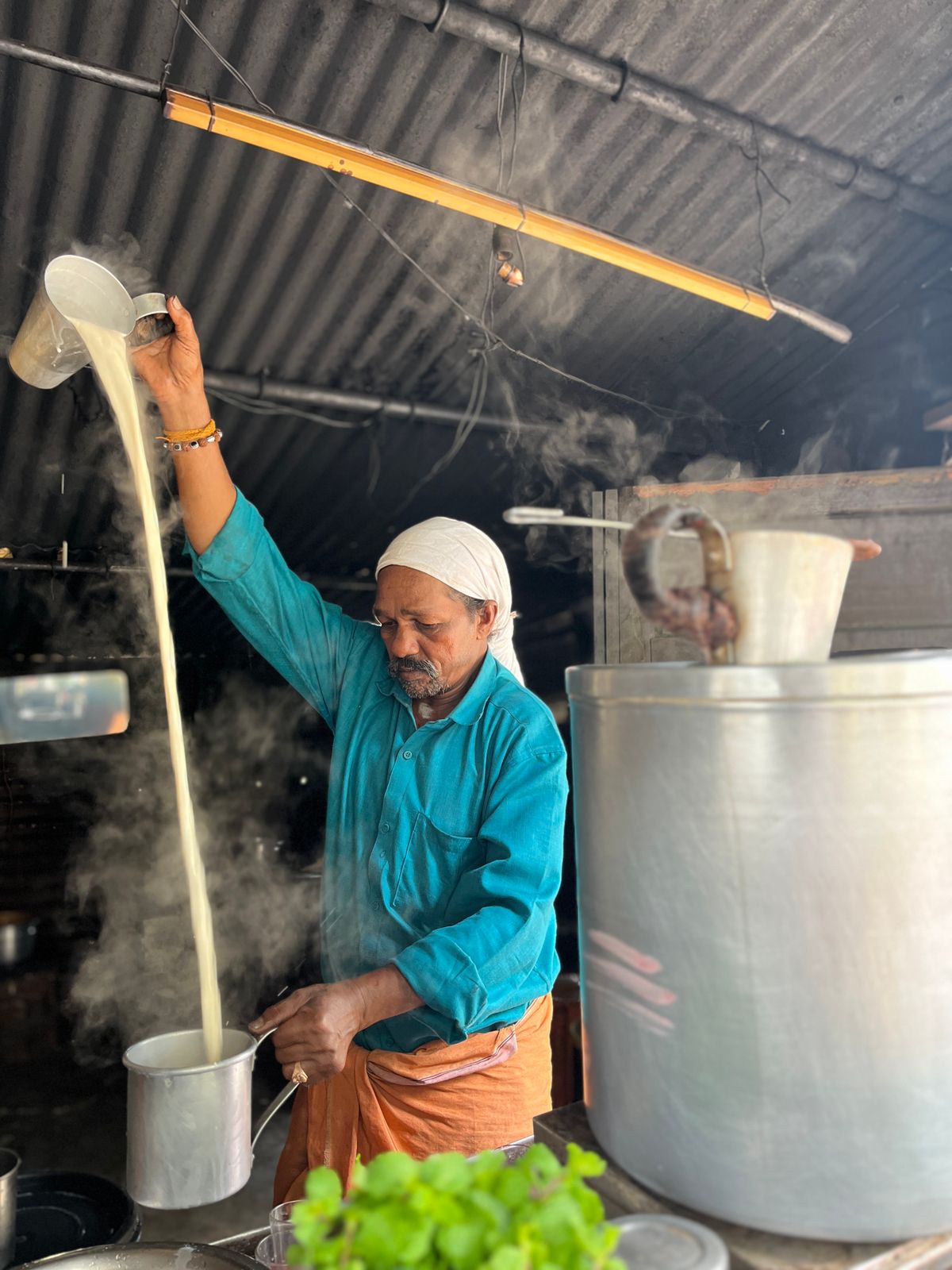
Cha chak — teh tarik to Malaysians — is strong black tea brewed thick, sweetened with condensed milk, and pulled: poured back and forth between two vessels from a height until it froths and cools to drinking temperature. The pull is not theatre, or not only theatre; it aerates the tea and builds the foam cap a good glass demands. A roti, a glass of cha chak, a marble-topped table and the morning market waking up around you — this is the Deep South's answer to the espresso bar, and it has been perfected over generations. Coffee exists, strong and sweet, but tea is the house drink and the one to order first.
Massaman's Southern Home
Gaeng massaman — the mild, dark, peanut-rich curry of beef or chicken with potatoes and roasted spices — is often described as a "Muslim curry," and its story is usually pinned to the royal court in Bangkok. But its soul is southern. The name itself echoes "Musulman," the old word for a Muslim, and the curry's architecture — dry spices like cumin, coriander seed, cardamom and cinnamon up front, tamarind for sourness, coconut for body, almost no fresh chilli heat — is the architecture of the Malay and Indian Ocean spice world. In the Deep South and up through Songkhla and Phuket, massaman is everyday food, eaten with roti as often as rice, and the southern versions tend to be deeper and less sweet than the capital's. If you have only had massaman from a Bangkok food court, eat it down here and recalibrate.
Sup: The Oxtail Soup Shops
Ask a local where to eat in Yala or Pattani town and someone will point you to a sup shop. Sup hang wua — oxtail soup — is a beloved institution: a clear, peppery, lime-bright broth with falling-apart oxtail, tomato, onion and fresh herbs, sharpened at the table with chilli and more lime. Around it orbits a family of soups in the same style — beef soup, chicken soup, a sour-spicy tom of local character — all built on the same principle: clean broth, real sourness, herbs at the end. A bowl of sup, a plate of plain rice, a small fiery sambal on the side: it is the region's comfort lunch, and the shops that serve it run with the efficiency of places that have done one thing for thirty years.
Ayam Golek: Chicken on the Spit
At markets and roadside stalls across the three provinces, whole chickens turn on spits over charcoal, basted as they go — ayam golek, "rolling chicken." The baste is the point: a coconut-milk sauce loaded with ground spices, brushed on layer after layer until the skin lacquers a deep burnished orange and the meat stays juicy under it. It is sold with the sauce pooled over, eaten with rice, and it is festive food — the thing ordered for family gatherings and picked up on the way home when the day has gone well. Golek is Malay home cooking wearing its best clothes, and it rarely makes it onto lists of "Thai food" at all, which is precisely why it belongs on this one.
Budu: The South's Own Funk
Every kitchen on this blog has a fermented heart. Laos has padaek. Cambodia has prahok. The Deep South has budu — and it is proud of it. Budu is fish, usually small anchovies, salted and fermented in sealed jars until it resolves into a dark, intensely savoury liquid, closer to a concentrated fish essence than to the thin nam pla of the central Thai table. Pattani's budu is the famous one, aged in earthenware and treated with the respect other regions give to vintage vinegar.
The classic way to eat it is buduทรงเครื่อง — budu dressed up: mixed with coconut milk or water, lime juice, lemongrass, shallots, chillies and herbs, served as a dip with a mountain of raw and blanched vegetables and plain rice. It is pungent, salty, sour and rich all at once — a first cousin in spirit to the Lao jeow and the Thai nam prik — and it is also the dressing that makes khao yam khao yam. If you have learned to love padaek through this blog's Lao pages, budu will feel like meeting a relative: same family logic, different accent.

Sweets: Small, Coconut, Constant
The Deep South sweetens the day in small bites rather than big desserts. Akok — known across the border as kuih akok — are little coconut-egg cakes baked in brass moulds over charcoal until the edges crisp and the centres stay custardy, sweet with palm sugar. Roti jala, "net bread," is a lacy crepe drizzled into a pan in a net pattern, rolled up and eaten with curry or sweet coconut sauce — proof that even the sweets here blur the savoury line. Add the Ramadan bazaar stalls groaning with kuih of every colour, sticky rice cakes wrapped in leaves, and shaved-ice sweets at the night markets, and you have a region that snacks sweetly all day long in portions sized for grazing.
The Morning Markets
Eat where the day starts. The Deep South's morning markets are its true dining rooms: fish still silver from the Gulf boats laid out on ice in Pattani and Narathiwat — mackerel, tuna, squid, prawns — next to stalls selling nasi dagang, khao mok and roti to go. Inland, toward Yala's hills, the fruit takes over: this is orchard country, home to mangosteen, rambutan, longkong and some of Thailand's most argued-over durian. Market breakfast culture here is serious and early — by nine, the best of it is done — and a visitor who sets an alarm eats better than one who doesn't. That is true everywhere on this blog, but it is doubly true in the south.

A Short, Honest Note on Visiting
One paragraph of plain dealing, because this blog does plain dealing. The Deep South has lived with a long-running insurgency and periodic violence, and travel advisories for Pattani, Yala and Narathiwat reflect that; check the current advice before you plan a trip and weigh it honestly. Many travellers — Malaysian visitors especially, and food people from all over — go regularly and eat magnificently, and daily life in the market towns is warm, ordinary and welcoming. The situation on the ground is the situation; the food is what this article is about, and it deserves its place on any serious map of Southeast Asian eating.
Go Deeper
This guide is the survey; the dishes get their own pages on this blog's Deep South Food tab, where khao mok gai already has a post of its own and the roti-and-tea morning has a home waiting. Pair it with the Malaysian Food tab to taste the same table across the border, and the Thai–Arab Fusion pages for mataba's wider family. The Deep South is the far end of the conversation this blog has been having all along — fermentation, rice, herbs and heat, spoken with a Malay accent.


Comments
Post a Comment