Bánh Xèo: The Sizzling Crepe of the South (and Centre)
Day three of this Vietnam series, and the kitchen moves south — you could hear this one coming from down the street. Yesterday's bún chà was Hanoi's quiet, brothy lunch. Bánh xèo is its opposite in almost every way: loud, golden, fried hard in a roaring-hot pan, and eaten with your hands, wrapped in leaves, in a cloud of steam and herbs. The word xèo is not a place or an ingredient. It is a sound — the long, fierce sizzle when a ladle of batter hits smoking oil. The dish is named after its own noise.
A Crepe, But Not a Dessert
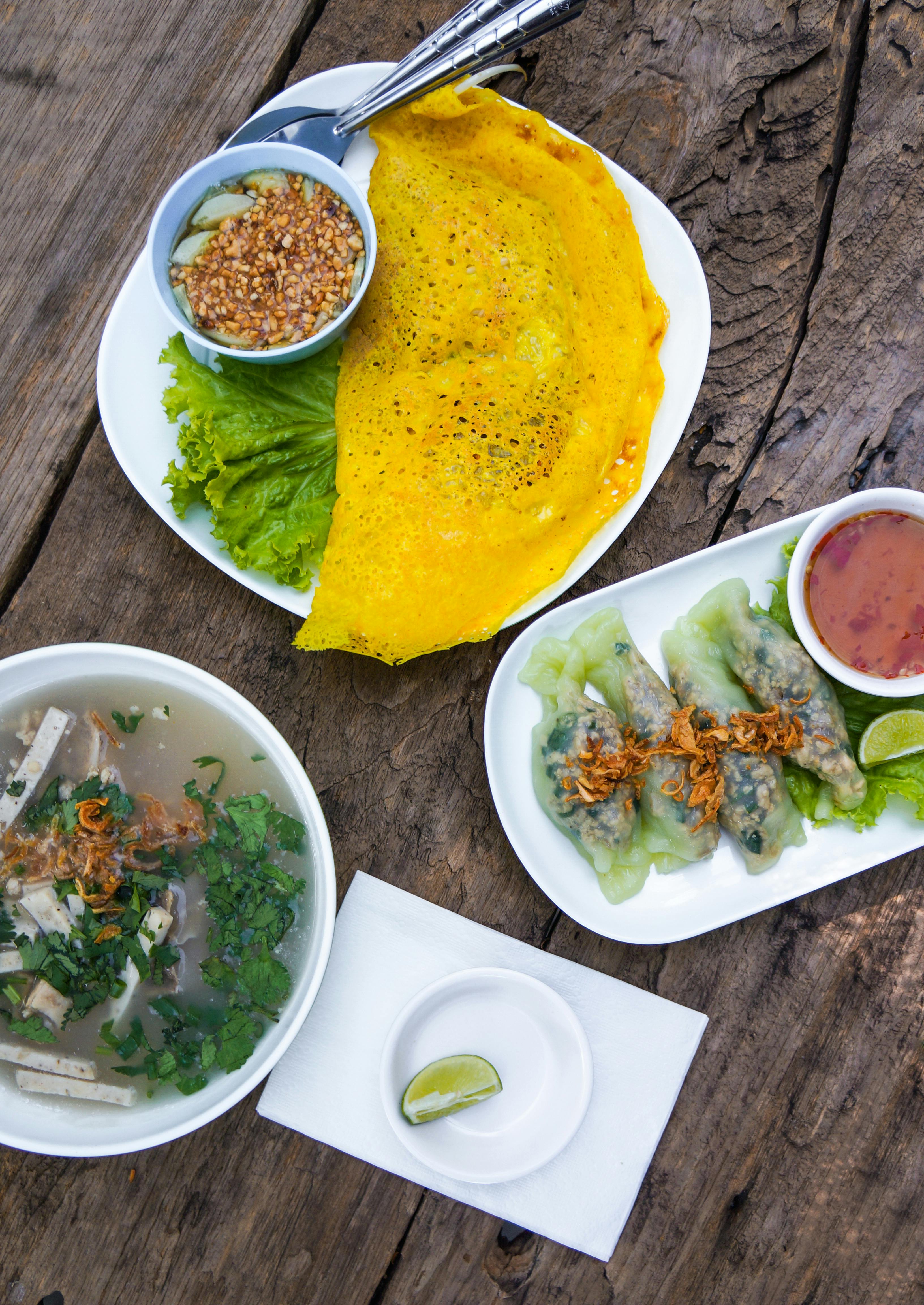
Western visitors see the shape and think French crepe, and the connection is not imaginary — Vietnam's kitchens absorbed French techniques and gave them back changed. But bánh xèo is a savoury, main-event dish. The batter is rice flour tinted deep yellow with turmeric, sometimes enriched with egg, poured thin into a well-seasoned wok or flat pan so hot the batter sets almost on contact. It fries into a lacy, shattering shell — crisp frilled edges, a slightly chewy centre — while the filling cooks inside it: slices of pork belly, whole small prawns in the shell, a handful of mung beans, and a tumble of bean sprouts added last so they steam rather than stew.
The finished crepe is folded in half like an omelette, slid onto a plate, and served big enough to share. It should crackle when you cut it. If it arrives limp, it sat too long — bánh xèo waits for nobody.
Two Sizes, Two Countries Within One
Travel the length of Vietnam and bánh xèo changes size at about the waist of the country.
The southern crepe — Saigon, the Mekong delta, and everywhere the south's generous spirit reaches — is made in a huge pan, sometimes the size of a wok lid, and comes out the diameter of a dinner plate or bigger. It is a table event: one crepe serves two or three people, cut into pieces at the table, and the filling is abundant — more pork, more prawns, sprouts heaped high. Southern cooks often stir coconut milk into the batter, which makes the edges fry up extra crisp and faintly rich, and delta versions can carry the region's abundance with it: more seafood, sometimes mushrooms, sometimes whatever the garden gives.
The central crepe — around Bình Định, Quảng Ngãi, and the central coast — is a different creature: small, thick-ish, cooked one at a time in a little round pan or earthen mould, roughly the size of a saucer. These are denser, chewier, less delicate, and they come out in stacks. Where the southern bánh xèo is a shared platter, the central one is personal — you eat two or three of your own, and the dipping sauce in the centre is often a thicker, more peanut-tinged affair than the south's clear, bright bowl.
Neither is the "real" one. They are two answers to the same batter, shaped by two regions — the centre, historically leaner, cooking small and close; the south, historically abundant, cooking big.
The Wrapping Is the Dish
Here is where bánh xèo becomes an event instead of a plate of food. Alongside the crepe arrives a small garden: leaves of mustard greens and lettuce, sprigs of herbs — fish mint, perilla, basil, mint — and often sheets of softened rice paper. You do not eat the crepe with a fork. You eat it like this:
Cut or tear a piece of crepe — make sure it carries pork, a prawn, some sprouts. Lay it on a mustard leaf or a sheet of rice paper. Add herbs, plenty of them. Roll it into a tight parcel. Dip the whole thing deep into nước chấm — the sweet-sour fish-sauce dip, often with shredded carrot and chilli floating in it — and eat it in two bites, three at most.
The contrasts are the point: hot crisp crepe against cool raw leaf, rich fried batter against the green bitterness of mustard leaf and the perfume of the herbs, then the dip over everything. Stall owners will happily demonstrate, and the first parcel you build will fall apart. The second one won't. By the third, the whole table is building, dipping and arguing about the ideal herb ratio, which is exactly the state bánh xèo is designed to produce.
The Huế Cousin: Bánh Khoái
Ride north into the old imperial capital, Huế, and you meet bánh khoái — bánh xèo's smaller, thicker, more formal relative. Khoái means "to enjoy" or "to be pleased," and the story told in Huế is that this was the version fit for the court: a compact crepe, fried with more egg in the batter, filled with prawn, pork and sprouts, and served with a sauce unlike anywhere else — a thick, warm, peanut-and-sesame dip, sometimes enriched with pork liver, that you spoon over rather than dip into.
It is bánh xèo thinking in a minor key: smaller, richer, sauce-led. If you pass through Huế, eat both and take sides at your leisure. The rest of the country will.
Street Theatre
The best bánh xèo is made at stalls that are half kitchen, half stage. The classic setup is a long charcoal brazier with three, four, five pans going at once, and a cook — very often a woman who has done this for decades — working them in rotation like a juggler: oil, batter, swirl, fill, sprouts, fold, out. She judges each pan by sound and smell, not by timers, and a good stall keeps a queue of orders shouted over the sizzling. Sit close if you can. Half the pleasure is watching five crepes at five stages land in perfect order, and the other half is that yours arrives still crackling, thirty seconds off the pan.
Shops that fry to order indoors are fine, and some are excellent. But the stall version — plastic stools, charcoal smoke, pans spitting — is where bánh xèo is most itself.

What It Costs
Bánh xèo stays firmly in street-food money. A big southern crepe at an ordinary shop typically runs in the region of 40,000 to 80,000 đồng depending on size and how generously it is filled; the small central crepes are sold by the piece, usually a few thousand đồng each, so a full plate still lands in a modest range. Fancier, famous-name restaurants charge more, as they do everywhere, and seaside tourist towns add their premium. Prices creep up year by year, but the shape of it holds: a table of friends, two big crepes, a mountain of herbs and a round of drinks remains one of the better-value feasts in Vietnam.
Go in the evening, find the loudest pan on the street, and order with your ears first. Tomorrow, the Vietnam series slows down for cơm tấm — Saigon's broken rice.


Comments
Post a Comment