Goi Cuon: Fresh Spring Rolls with Peanut Sauce
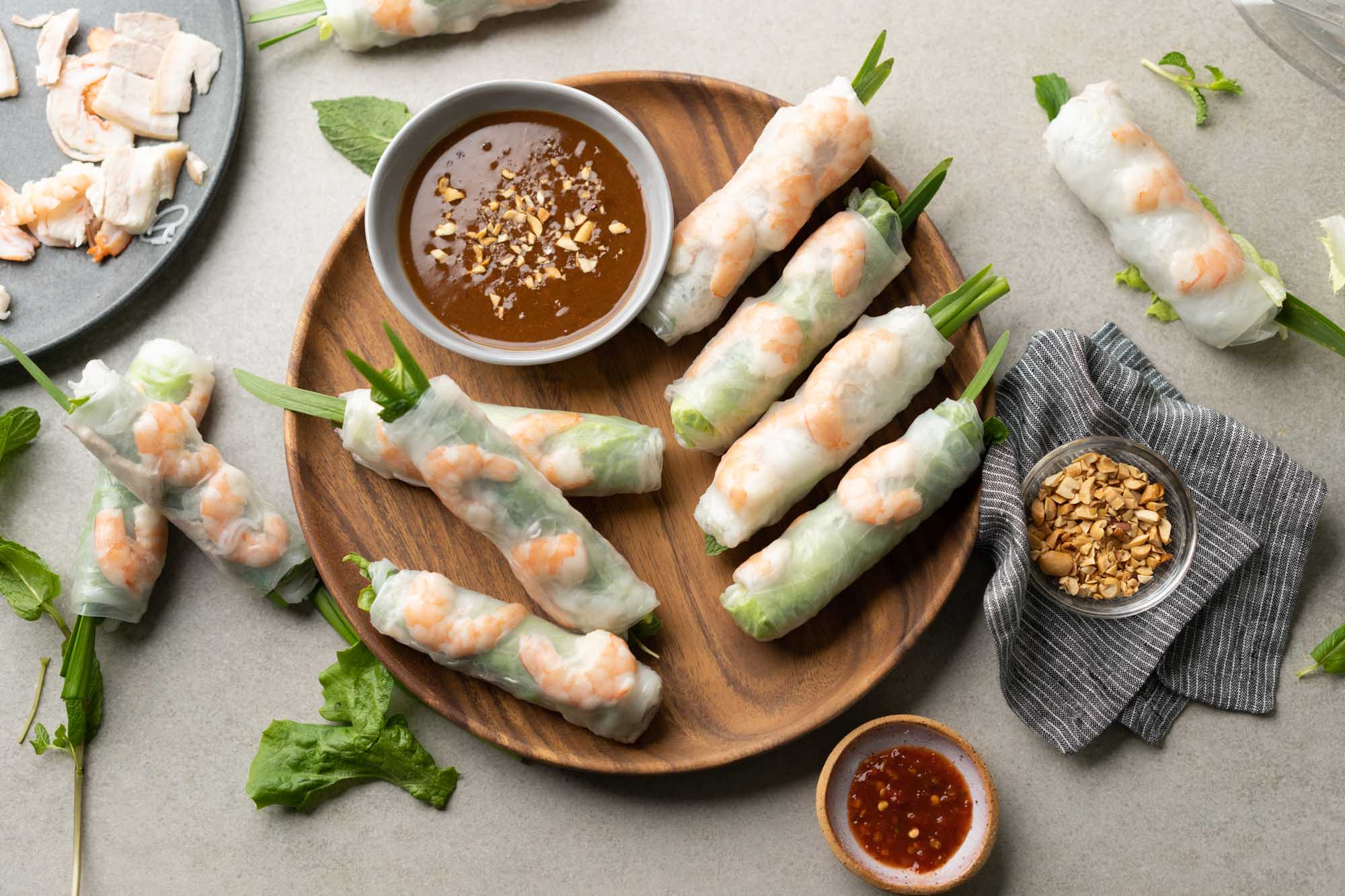
Photo: Hungry Huy
Goi Cuon: Fresh Spring Rolls with Peanut Sauce
There is a moment, just before you roll, when a goi cuon is still a small, perfect garden on a round of wet rice paper: green lettuce, a tangle of mint and herbs, white rice noodles, a slice of pork, and prawns laid pink-side down so they will shine through the finished roll. Then you fold, tuck and roll, and it becomes something else entirely — a cool, translucent parcel, fresh as a salad and satisfying as a meal, made to be dunked deep into peanut sauce.
Fresh, not fried — that is the whole point
Goi cuon comes from southern Vietnam, and it is the fresh counterpart to the fried spring roll, cha gio. Nothing here is fried, nothing is heavy. Goi points to salad, cuon to rolling, and that is exactly the spirit: salad ingredients rolled up in softened rice paper — banh trang — and eaten at once, while the herbs are still bright and the wrapper is still supple. In Saigon — Ho Chi Minh City — you find them everywhere: at market stalls where a vendor rolls to order with astonishing speed, in family homes where a whole table rolls its own, and in restaurants far from Vietnam, where goi cuon is often the first Vietnamese dish a newcomer learns to love.
The prawns show through on purpose
A good goi cuon is honest food, and you can see it. The rice paper turns nearly transparent when it is wet, so the cook lays the halved prawns cut-side out against the wrapper. When the roll is finished, those pink prawns show through in a neat row, with the green of a garlic chive poking out of one end like a handle. It is practical — you can see exactly what you are getting — and it is beautiful, which in Vietnamese cooking is rarely an accident. Slice the pork thin, keep the herbs whole and generous, and the roll does the showing off itself.
The parts that make the roll
- The wrapper: round dried rice paper, dipped briefly in lukewarm water until just pliable — soft, never soaked to mush
- The prawns: poached until just pink, halved lengthways and laid cut-side out so they show through the roll
- The pork: a slice or two of gently poached pork belly or shoulder, tender and mild against the herbs
- The noodles: a small bundle of thin rice vermicelli, giving the roll body and chew
- The green: lettuce, mint, Thai basil, perilla and coriander, plus a garlic chive laid so its green tip sticks out of the end
- The sauce: a warm, rich peanut sauce — hoisin-based, loosened and enriched — topped with crushed roasted peanuts; some tables also serve a lighter fish-sauce dip, nuoc cham
The sauce is not an afterthought
Ask ten cooks about goi cuon sauce and you will start a friendly argument. The classic southern partner is tuong — a peanut sauce built on hoisin, warmed with a little of the pork-and-prawn poaching liquid or coconut milk, loosened with peanut butter or finely ground roasted peanuts, and finished with a spoon of chilli and a shower of crushed peanuts on top. It is sweet, savoury, nutty and just thick enough to cling to the cool roll. The contrast is the dish: cold, herbal, crunchy freshness in one hand, warm, rich, comforting sauce in the bowl. One without the other is only half the story.
Rolling is a table ritual
The best way to eat goi cuon is the way Vietnamese families do it: everything laid out in the middle of the table — a bowl of warm water, a stack of rice papers, plates of herbs, noodles, pork and prawns — and everyone rolling their own. First rolls are lumpy. Second rolls are better. By the third, you have learned the two real secrets: wet the paper less than you think, and do not overfill. The paper keeps softening after its dip, and a modest filling rolls tight and neat, while a greedy one bursts. Nobody minds a burst roll at a family table, though. You just dip it a little more carefully and eat the evidence.
Home recipe: Goi Cuon (makes 12 rolls, serves 4 as a starter)
- Cook the fillings: poach 250g pork belly or shoulder in salted water for about 20 minutes until just cooked; lift it out, cool and slice thinly. In the same water, poach 12 large prawns for 2–3 minutes until pink; cool, peel, devein and halve lengthways. Keep 200ml of the poaching liquid for the sauce. Cook 100g rice vermicelli as the packet directs, drain, rinse cold and set aside.
- Make the peanut sauce: warm 150g hoisin sauce with 3 tablespoons smooth peanut butter (or finely ground roasted peanuts) and about 150ml of the reserved poaching liquid, stirring until glossy and pourable. Add a teaspoon of sugar, a squeeze of lime and chilli sauce or finely chopped fresh chilli to taste. It should be sweet first, then nutty and savoury. Pour into small bowls and top with crushed roasted peanuts.
- Prepare the green: wash and dry 12 small lettuce leaves, a generous bunch each of mint, Thai basil and coriander (plus perilla if you can find it), and 12 garlic chives (or spring onion greens). Everything should be dry-ish so the rolls do not slip.
- Set up: fill a wide bowl with lukewarm water. Work one roll at a time on a clean board or plate, with all the fillings within reach.
- Roll: dip one rice paper in the water for just a few seconds until it begins to soften, then lay it flat. Across the lower third, lay a lettuce leaf, a small bundle of noodles, pork slices and herbs. Fold the bottom edge up over the filling, fold in the sides, roll once, then lay 2 prawn halves cut-side down and a garlic chive across so its tip will poke out, and roll up firmly to finish. The prawns should show through the paper.
- Serve at once on a plate — not touching each other too closely, or they stick — with the warm peanut sauce for generous dunking. Eat within the hour; fresh rolls wait for no one.
Vegetarian table? Easy: swap the pork and prawns for slices of seasoned fried tofu and extra herbs and noodles, and build the sauce with coconut milk instead of poaching liquid — the rolls stay just as fresh, and the tofu takes on the peanut sauce beautifully.
Why the fresh roll travels so well
Goi cuon endures because it tastes like where it comes from: generous herbs, clean flavours, food made by hand and shared at the table. It is light without being slight, pretty without being fussy, and endlessly adaptable once you have rolled your first dozen. Make them once for friends and you will be asked to make them again — and next time, let everyone roll their own. That is when a plate of spring rolls becomes a proper Saigon evening, anywhere in the world.


Comments
Post a Comment